


Responso Call Center for E-commerce: Why the Old Phone Support Model Costs More Than You Think


Table of contents
Many e‑commerce stores still answer customer calls with a PBX, IP desk phones and several systems open at once in separate browser tabs – and pay far more for it than it seems at first glance. An agent without access to order history and previous conversations wastes the customer’s time, their own time and your budget, and one bad contact is enough to send a buyer to the competition. In e‑commerce, this model has simply stopped paying off.
At Base EXPO’26, Daniel Formela, CEO of Responso, said it plainly: the phone in e‑commerce isn’t dying. What’s dying is the call center that only answers the phone.
It sounds like a catchy slogan, but it’s backed by data most store owners know from their own experience – they just rarely translate it into money.
Why Is the Classic Call Center No Longer Working in E‑commerce?
How much do WISMO and repetitive questions cost in e‑commerce?
Between 18% and 25% of all e‑commerce support tickets are so-called WISMO – “Where is my order?“ In peak season, during Black Friday and Christmas, this share can rise to as much as 50%. Handling a single WISMO ticket manually costs $4–12, counting agent time, systems and escalations. And phone support is the most expensive channel: in the UK, the average inbound call costs £6.17 – 25% more than an e‑mail and 83% more than a web chat (ContactBabel, 2026).

Source: “Why the classic call center will die and what will replace it” — Daniel Formela, Base EXPO’26
In a classic call center, the agent answers the phone, asks the customer for the order number, logs in to three systems and starts searching… and only then gives the status or passes the case on. This isn’t an exception: according to Forrester, agents spend up to 35% of their time searching for information, and Salesforce found that service reps spend less than half of their time (46%) with customers – the rest goes to administrative tasks and internal work.
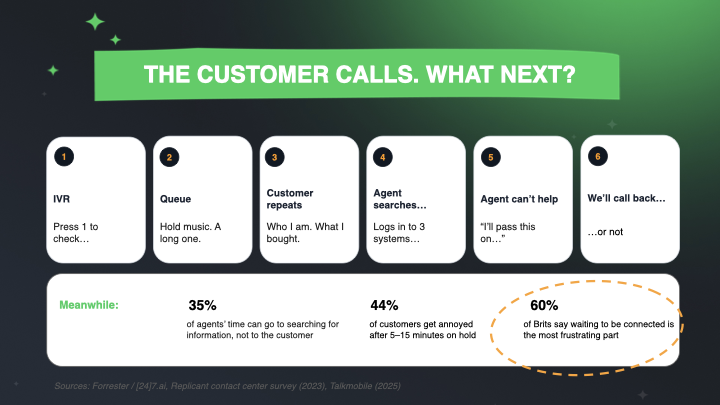

Source: “Why the classic call center will die and what will replace it” — Daniel Formela, Base EXPO’26
The result? The customer waits on hold, explains everything from the beginning, and often still doesn’t get an answer during the call. It’s no surprise that 60% of Brits say waiting to be connected is the most frustrating part of calling customer service (Talkmobile), and 44% of customers get annoyed or angry after just 5–15 minutes on hold (Replicant).
For an online store, this frustration has a very specific price. An irritated customer doesn’t call back – they leave a negative review, cancel the order or simply buy from a competitor next time. And it often takes just one bad contact with customer service. All the more painful when most of these calls are simple questions like “Where is my order?”, which could be answered in seconds.
Customers say they want a human… and choose a bot.
79% of US consumers strongly prefer talking to a human over an AI agent – according to a 2025 SurveyMonkey study. But when customers want an immediate answer, 51% prefer a bot to waiting for an agent (Zendesk).
Above all, the customer wants their problem solved – and if a bot does it faster, the bot wins. All of this, however, on one condition: it has to be easy to talk to a person when the situation really calls for it. 89% of customers believe companies should always offer the option to speak with a human (SurveyMonkey).
This leads to a clear division of work, which we presented at Base EXPO’26:
AI takes over:
- order status, tracking, ETA
- shipping methods and delivery times
- return policies, link to the return form
- product availability, sizes, colors
- questions about invoices, opening hours, current promotions
- all repetitive cases – 24/7
A human takes care of:
- complaints that require a decision
- upset customers
- shipping errors and lost parcels
- consultative sales and B2B customers
- everything that requires empathy
How much can AI handle today? In an analysis of real data from 13 vendors, the best AI implementations resolve about 70% of customer queries, with a median of 48% (SaaStr). And this share will keep growing: according to Gartner, by 2029 AI will autonomously resolve 80% of common customer service issues.
How Much Can You Save by Implementing AI in Your Call Center?
Take the example of an online bookstore presented at Base EXPO’26. In peak season, it employs 30-40 full-time agents in its call center and helpdesk. 60-70% of conversations are one and the same request: “I have a list of 12 books – can you find them for me?”. The agent searches for each title manually in Magento, then on Amazon, copies the links, sends an e‑mail – that’s 12 minutes per conversation.
What does it look like when AI helps the customer service team? The customer asks, the system matches the titles, and the reply with links goes out automatically. The customer gets a ready shopping cart almost instantly, without the team’s involvement – and the team can focus on other, more demanding cases in the meantime.

Source: “Why the classic call center will die and what will replace it” — Daniel Formela, Base EXPO’26
Assuming AI handles only 40% of conversations, you need 24 full-time agents instead of 40. With a typical UK customer service advisor salary of around £26,000 a year and a six-month season, the difference comes to about $279,000 (€245,000). Even at the National Living Wage of £12.71 an hour, it would still be about $266,000 (€234,000). And that’s counting salaries only – without recruitment, employer National Insurance contributions, training and staff turnover, which can even double the bill.
How Does Call Center in Responso Work? Technology Without a PBX
Emil Szymanek, Tech Lead at Responso, ran a technical Masterclass at Base EXPO’26 and put it bluntly: Call Center in Responso runs on Amazon Connect and has zero hardware requirements.
How is Call Center in Responso different from traditional VoIP?
In a traditional VoIP (Voice over IP) call center, you need a PBX – on-premises or cloud-based (3CX, Asterisk, FreePBX) – IP phones on every agent’s desk, SIP trunks from a voice provider, servers with QoS configuration, power, backup and an IT administrator to make sure everything works as it should. It’s a “buy and maintain” model – license costs are fixed and scale by buying more seats.
In Responso, an agent needs a computer, a headset and a browser. That’s it. 😉
What does the call flow look like in Responso Call Center?
The flow has four steps:
- The call reaches the Amazon Connect instance assigned to the Responso account,
- Contact Flow defines routing, IVR and queuing visually – without writing code,
- Lambda and the API pull the customer’s context from the CRM before the agent picks up,
- The CCP (Contact Control Panel) is built directly into the Responso interface, so the agent doesn’t switch windows.
The whole AWS stack – Amazon Connect, Lambda, S3 (recordings), CloudWatch, API Gateway – is connected with the agent panel through the Responso API.
As a result, the agent answers the phone and immediately sees the customer’s order history, previous tickets and the sentiment of their recent messages – before the customer even introduces themselves.

Source: “Call Center Technology in the Age of the AI Revolution” — Emil Szymanek, Base EXPO’26
What does Responso do with a call after it ends?
This was the part of the Masterclass that impressed the audience most. When a call ends, Responso automatically generates a transcript – a full, searchable record of the conversation – a sentiment analysis, showing whether the customer was calm, irritated or upset, and a ticket that lands in the same place as e‑mails, Amazon messages and chat.
→ Talk to a Responso specialist about Call Center
One view with the customer’s entire history in one place – whether they wrote, called or talked to a bot.
When Should You Implement AI in E‑commerce Customer Service?
This decision is usually postponed until the chaos in customer service starts to cost real money – longer queues, irritated customers, full-time positions spent on questions the system could handle on its own.
According to McKinsey, 88% of organizations already use AI in at least one business function, but only about a third have started scaling it across the company – and that gap between “we’re testing it” and “it works for us every day” is what decides competitive advantage today.
But AI alone doesn’t guarantee a return. In Gartner’s analysis of 432 AI use cases in customer service, only a quarter produced ROI. What makes the difference is the foundation: companies that bring all their service channel data into one platform are 1.4 times more likely to call their AI implementation very successful (Salesforce). Service teams expect AI agents to cut service costs and resolution times by about 20%. And when it comes to cost per conversation, UK data speaks for itself: a web chat costs around 45% less than a phone call (ContactBabel).
How to Stop Overpaying for Customer Service in Your Store?
If your team handles repetitive questions by phone today, you have a measurable problem with a specific price you pay every month. Responso brings all your communication channels together – marketplaces like Amazon, store platforms like Shopify and Magento, Base, e‑mail, chat and now the phone – in one panel, where the AI Assistant takes over repetitive questions and agents get time for the things that really need a human.
And if you’d like to see how the rest of Responso works first, try the platform free for 14 days, no credit card required. Setup takes less than 15 minutes.


