
Running an e-commerce or any other business means your customers are talking to you. They leave reviews on marketplaces like Amazon or Walmart, send you private messages via chats or emails, or tag and comment on your posts on social media. These interactions can be true fuel for your business growth and success. But how do you process all of them effectively?
In 2026, gathering, organizing, and analyzing customer insights on products and services is a must for every business. In this article, we will break down what customer feedback analysis is, explore the rise of sentiment analysis for customer feedback, and show you exactly how to do customer feedback analysis using modern AI tools.
What is Customer Feedback Analysis?
Customer feedback analysis is the process of collecting, categorizing, and analyzing the opinions that customers leave on every touchpoint with your e-commerce business. It includes different types of interactions — ranging from a product review to a completed survey.
The feedback analysis can be quantitative or qualitative.
- Quantitative analysis is used to measure numeric and statistical data via methods such as statistical analysis and scoring frameworks (CSAT, NPS, etc.). This approach identifies broad patterns of customer satisfaction.
- Qualitative analysis is used to understand a deeper meaning, motivations, and emotions lying behind customer behavior. Qualitative analysis uses unstructured data via interviews or open-ended reviews.
Implementing these two approaches helps to understand what is happening, as well as why it happens.
Historically, employees would review and tag customer feedback manually. It was time-consuming, costly, and inconsistent. For example, one employee could tag “slow shipping” as a logistics issue, while another could tag it as a customer service problem. So, the data was inaccurate.
Nowadays, the volume of data has significantly increased and can reach thousands of reviews daily, so sorting and analyzing them manually is virtually impossible. The modern customer feedback analysis approach relies on tools that use Natural Language Processing (NLP) to read every word at scale. It also identifies patterns you may miss.
The Power of Sentiment Analysis for Customer Feedback
Sentiment analysis is considered a qualitative analysis method and thus helps to understand the emotions behind customer feedback. Usually, sentiment analysis for customer feedback is used to classify customer opinions as positive, neutral, or negative. However, modern tools powered by AI (like Responso) have gone further and offer a broader classification, such as:
- positive
- promotional
- negative
- threatening
- urgent
- offensive
In Customer Support, customer feedback analysis became a crucial part since, statistically, nearly 30% of customers stopped using or buying from a brand due to bad customer experience. Those having negative customer journeys may also harm your business by posting their stories on popular social media. Thus, sentiment analysis is important since it helps you respond to problems faster.
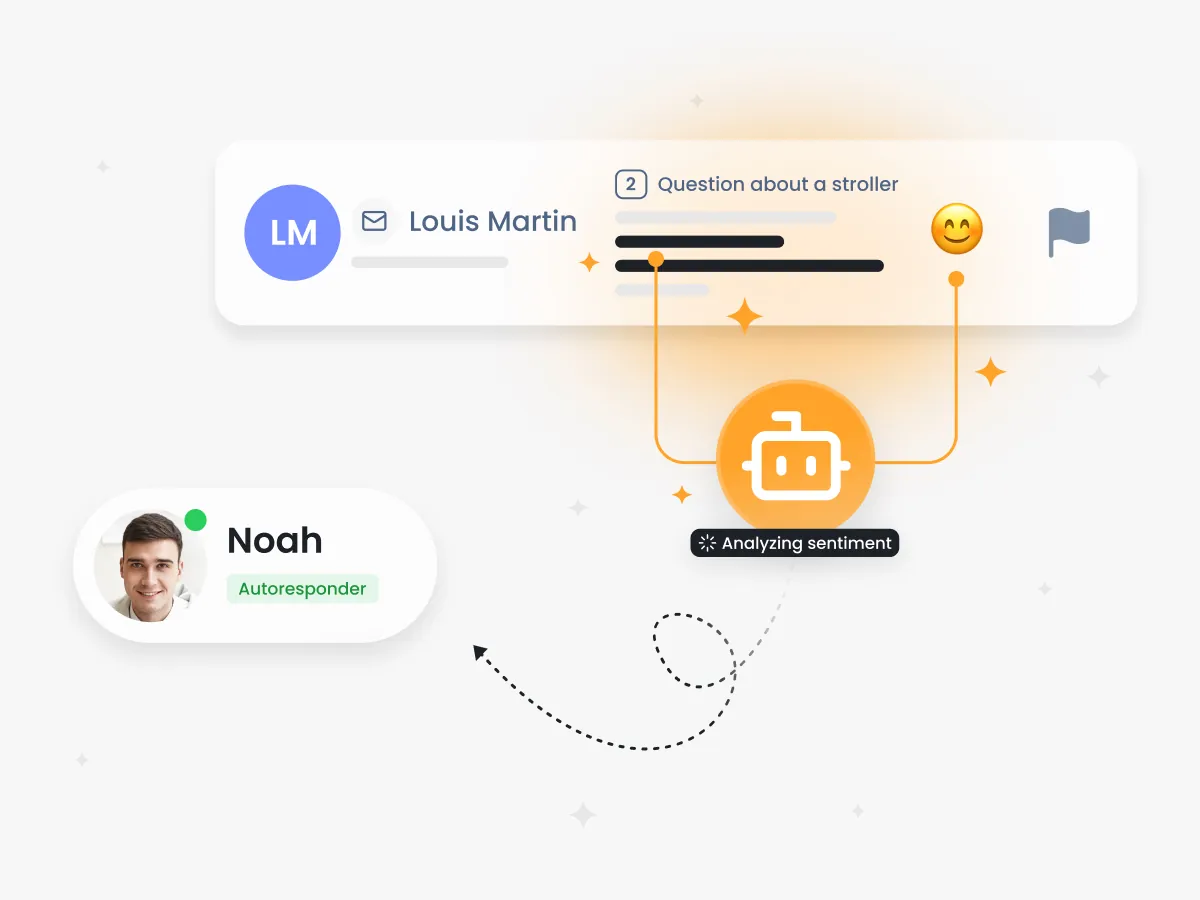
For example, Responso AI reads the context and assigns sentiment to each inquiry. Additionally, in case of urgent matters, it notifies you via email so you can react instantly.
Why Sentiment Analysis is a Better Approach?
To answer this question, consider this example:
You sell women’s clothes. Under one shirt you get two reviews with the same rating (4*).
Review 1: The shirt is ok. Fits well. (Rating 4*).
Review 2: I love this shirt! It’s so nice in touch and fits perfectly! The color is a bit different from the photos, but still looks amazing! (Rating 4*).
You have two reviews with the same rating (4*), but customer feedback sentiment analysis reveals a massive difference. The first review sounds neutral (or neutral-to-positive), while the second is passionate (highly positive with a minor issue). If you analyze only ratings, you would treat them the same. But if you take sentiment analysis into account, you know to reward this passionate customer and fix the problem for the next customers.
How Sentiment Analysis Works?
When you run customer feedback sentiment analysis, the AI breaks down the sentence structure. It looks for “sentiment-bearing words” – like “love,” “recommend,” and “fast” for positive; “hate,” “broken,” and “expensive” for negative – as well as negations such as “not bad” (which is actually positive) or “not good” (which is negative).
However, advanced AI customer feedback analysis models also include context and read surrounding words. For example, a customer leaves a review that says, “The sneakers are sick!” In a literal, clinical context, “sick” is negative. But in modern e-commerce slang, “sick” means “cool,” “awesome,” or “visually striking.” A basic sentiment tool might flag this review as negative or neutral, causing you to mistakenly think a customer hates your product.
Leveraging AI Customer Feedback Analysis
Customer feedback analysis powered by AI can transform your business in several key ways. Here are a few of them:
Improve the Customer Journey
A customer journey is the complete process of a person’s interaction with a brand – from initial awareness through purchase and retention, ultimately leading to advocacy. The process includes all interactions (touchpoints) across all channels, both direct (e.g., a support call) and indirect (e.g., a social media mention).
Understanding their experience helps you adapt your products or services and your marketing strategy to customers’ needs and market demands. Additionally, it helps identify effective ways to communicate with your customers and determine issues that a customer experiences with your product or service so you can address them immediately. AI-powered tools identify weak points and negative sentiment in real time. So, you and your team can react and support a customer at the very beginning of a problem.
Automated Workflow
AI context and sentiment analysis can tag and categorize inquiries automatically by keywords and handle the easy ones without a human being involved. So, the team can focus on resolving the more complex inquiries without worrying about which one is more important. Also, AI can assign a specific employee – for example, someone with more experience or expertise – to solve more complex matters. Thus, everyone knows what to do, and it prevents bottlenecks in inquiry management.
More Accurate Reports
AI can gather and analyze large volumes of data within seconds. It delivers insights on CSAT and support tickets in real time, so you can adjust quickly by implementing a better solution. AI can also instantly gather information from customers at every touchpoint with your business — from interactions with support agents and bots to reviews — and find weak points to work on, such as slow delivery, product dissatisfaction, or poor customer support. This helps you improve faster while minimizing damage to your reputation.
Predictive Insights
Nowadays, AI can predict whether a customer will churn and their next move based on the context of a message. For example, if a customer writes, “The product seems nice, but I’m looking for a cheaper alternative,” AI flags the message, and your team can offer a discount to this customer.
Before vs. After AI Integration
| Traditional Analysis (Manual) | AI & Automation | |
| Data Organization | Chaos: Switching between Amazon, eBay, and Social Media tabs manually | Unified Hub: All data for customer feedback analysis in one place |
| Accuracy | Subjective: Tired employees miss nuances or misinterpret tone | Precise: Customer feedback analysis ai is 100% objective 24/7 |
| Response Time | Reactive: You find out about a crisis after your rating has already dropped | Proactive: Sentiment analysis flags “Angry” messages for instant reaction |
| Reports | Guesswork: “I feel like people are complaining about shipping” | Facts: “Data shows 34% of negative feedback is due to a specific carrier” |
| Scalability | Linear: To handle more feedback, you must hire more people | Exponential: AI handles 10,000 messages as easily as 1 |
How to Do Customer Feedback Analysis
Step 1. Centralize your data
Use a single place to unify your data — like Responso for 360-degree customer support. Using multiple platforms and messaging services leads to inaccurate or missed information. You cannot analyze what you cannot see.
Step 2. Categorize and Tag
Sort out feedback by tags like sentiment, topic, and urgency. Use sentiment analysis to categorize inquiries as positive, negative, or neutral.
In terms of urgency:
- high
- medium
- low
And by topic, such as pricing, customer service, quality, and shipping.
Step 3. Quantify the Qualitative
Transform subjective data into numeric metrics. If 35% of feedback is complaints about “shipping time,” you have a measurable problem to work on. Use AI tools to create charts and visual boards to make the process easier.
Step 4. Action and Response
Analysis without action is a waste of time and money. If a customer provides negative feedback, use your AI assistant to draft a personalized, empathetic response that addresses their specific pain point. When the issue is resolved, follow up.
You now understand what is customer feedback analysis, why sentiment analysis for customer feedback beats star ratings alone, and exactly how to do customer feedback analysis with AI. But knowing is not enough – acting is. Every day you rely on manual processes or basic tools, you miss urgent complaints, misread passionate praise, and lose customers who expect to be heard immediately. Responso helps you take control by organizing, centralizing, and streamlining your customer feedback workflow – so you and your team can respond faster, prioritize smarter, and turn insights into action.
Try Responso free for 14 days – no credit card required. See how effortless customer feedback management can be.
Your customers are already talking. Make sure you are truly listening.
FAQ
What is the best method to collect customer feedback?
The best method is multi-channel collection. Don’t rely solely on one source. Combine proactive methods (like post-purchase surveys) with passive methods (like monitoring marketplace reviews and social media). Using a tool that centralizes these channels ensures you get a 360-degree view of the customer journey.
How exactly does AI improve customer feedback analysis?
AI improves the process through speed, scale, and objectivity. Humans are subjective and get tired; AI can analyze numerous comments with the same level of accuracy as the first one. It identifies hidden correlations – like a specific warehouse location being linked to a spike in negative “Product Condition” feedback – that a human might miss.
How often should companies analyze customer feedback?
In the fast-paced world of e-commerce, real-time analysis is the gold standard. While a deep-dive “monthly report” is good for long-term strategy, you should have AI tools monitoring sentiment daily to catch emerging crises or viral trends as they happen.
Can small businesses afford AI-driven feedback tools?
Absolutely, and this is a common misconception. Five years ago, AI customer feedback analysis cost thousands of dollars per month and required a data science team. Today, platforms like Responso offer affordable tiered pricing starting as low as $15-$50 per month for small businesses.
In fact, small businesses arguably need AI more than enterprises because they cannot afford a dedicated community manager. With AI, a solo founder can manage hundreds of reviews across different platforms in 15 minutes a day. The ROI is immediate: by catching a single negative review early (e.g., “Your store hours are wrong online”) and fixing it, you save one lost customer. That one customer is often worth more than the monthly subscription fee.